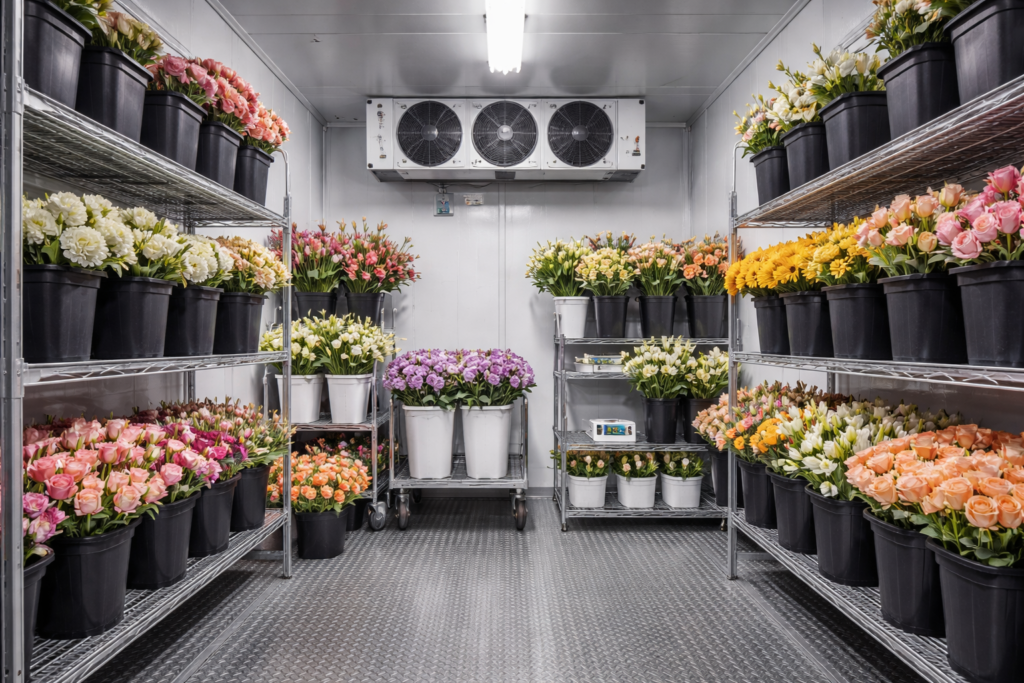

Building a walk in cooler for flowers is fundamentally different from building one for food, beverages, or meat. While many people assume that “cold is cold,” flowers are biologically sensitive products that respond dramatically to temperature fluctuations, humidity imbalance, and improper airflow. A poorly designed flower walk in cooler can shorten vase life, cause dehydration, promote mold growth, and ultimately lead to significant product loss.
This guide walks through the exact considerations professionals use when designing and building walk-in coolers for florists, flower shops, wholesalers, and greenhouses. Whether you are building a DIY unit or planning a semi-custom installation, understanding these principles will help you avoid the most common and costly mistakes.
Understanding Flower Storage Requirements
Flowers are living plant material even after being cut. They continue to respire, release moisture, and react to their environment. This is why their storage requirements are far more precise than those of packaged food products.
From a temperature standpoint, most cut flowers perform best in a medium-temperature range, typically between 34°F and 38°F (1°C–3°C). Going below this range risks chilling injury, which can manifest as petal browning, translucent tissue, or premature wilting once flowers are removed from cold storage. On the other hand, temperatures above 40°F accelerate respiration and dramatically shorten shelf life.
Humidity is equally critical. Flowers require high relative humidity, usually between 90% and 95%, to prevent dehydration. Standard walk-in coolers designed for food often operate at much lower humidity levels, which is acceptable for meat or dairy but disastrous for floral products. Low humidity causes moisture loss through transpiration, leading to limp stems, dry petals, and reduced visual quality.
Airflow must be carefully controlled. Excessive airflow can strip moisture from flowers, while stagnant air encourages mold growth and uneven temperatures. The goal is gentle, consistent circulation that maintains uniform conditions throughout the space without directly blasting flowers with cold air.
Understanding these three factors—temperature, humidity, and airflow—is the foundation upon which every successful flower walk-in cooler is built.
Choosing the Right Size and Layout for a Flower Walk-In Cooler
Sizing a flower walk-in cooler is not just about square footage. It is about volume, vertical clearance, and workflow.
Florists often store flowers in tall buckets or long boxes, which require more vertical space than standard shelving. A ceiling height of 8 feet or more is typically recommended to accommodate upright arrangements and hanging storage systems. Wholesale operations may require even greater clearance for palletized boxes.
Layout planning should begin with how flowers enter and exit the cooler. Consider whether you are storing:
-
Loose stems in water buckets
-
Pre-made bouquets
-
Boxed flowers for wholesale distribution
Each use case affects aisle width, shelving depth, and door placement. Narrow aisles may maximize storage capacity but can slow down daily operations and increase the risk of physical damage to flowers.
Another overlooked factor is future growth. Many florists outgrow their first cooler within a year or two. Designing a slightly larger space or allowing for future panel expansion can save thousands of dollars in reconfiguration costs later.
Professionally designed flower walk-in coolers prioritize accessibility and airflow just as much as storage density.
Selecting Insulated Panels and Flooring for Floral Environments
Insulated panels form the structural shell of a walk-in cooler, and for flower applications, panel selection directly affects humidity stability and energy efficiency.
Most flower walk-in coolers use 4-inch or 5-inch insulated panels with high-density foam cores. Thicker panels offer better thermal resistance, which is especially important in warm climates or non-climate-controlled buildings. Stable interior temperatures reduce compressor cycling and help maintain consistent humidity.
Surface finish matters more than many DIY builders realize. In high-humidity environments, panels should have non-porous, corrosion-resistant finishes that resist mold and are easy to clean. Improper finishes can discolor, warp, or harbor microbial growth over time.
Flooring is another critical element. Flowers are frequently stored in water-filled containers, making spills unavoidable. The floor should be:
-
Water-resistant
-
Non-slip
-
Easy to sanitize
Many professionals recommend sealed aluminum or reinforced insulated floors with textured finishes. Concrete floors may work but require proper vapor barriers to prevent moisture migration and insulation breakdown.
A well-sealed panel system ensures that humidity remains inside the cooler rather than escaping into surrounding spaces.
Refrigeration System Selection for Flower Walk-In Coolers
The refrigeration system is the heart of the walk-in cooler, and choosing the wrong system is one of the most common and expensive mistakes.
Flower walk-in coolers require medium-temperature refrigeration systems, not freezer systems. Overpowered systems designed for freezing environments can cause excessive moisture removal, rapid temperature swings, and compressor short cycling.
Evaporator coil selection plays a major role in humidity retention. Larger coils with slower fan speeds tend to preserve moisture better than compact, high-velocity units. The goal is to cool the space gently and evenly, not aggressively.
Condenser placement also matters. Outdoor condensers are common for commercial installations, but they must be sized correctly for the climate. In hot regions, undersized condensers struggle to maintain stable temperatures, which can stress flowers during peak heat hours.
Proper system sizing should account for:
-
Cooler volume
-
Door opening frequency
-
Ambient temperature
-
Desired humidity levels
Professionals calculate refrigeration load carefully to avoid oversizing or undersizing, both of which negatively impact flower quality and energy efficiency.
Humidity Control and Ventilation Solutions for Flower Coolers
Humidity control is where flower walk-in coolers truly differ from standard commercial coolers.
In many cases, the refrigeration system alone cannot maintain the high humidity flowers require. This is why professional installations often integrate dedicated humidification systems. These systems introduce controlled moisture into the air without creating condensation on walls or ceilings.
Ventilation must be balanced carefully. Flowers emit ethylene gas, which accelerates aging. While excessive ventilation dries out the space, insufficient air exchange allows ethylene to accumulate. Some high-end flower coolers incorporate air exchange or filtration strategies to manage gas buildup while preserving humidity.
Fan placement is another subtle but crucial detail. Fans should distribute air evenly without directing cold airflow straight onto flowers. Poor fan placement leads to uneven temperatures, dry spots, and inconsistent flower quality across the cooler.
When humidity and ventilation are properly balanced, flowers retain freshness longer, colors remain vibrant, and waste is significantly reduced.
Common Mistakes and Maintenance Tips for DIY Flower Walk-In Coolers
Even well-intentioned DIY builds often fail due to a few recurring mistakes.
One of the most common issues is overcooling. Setting temperatures too low in an attempt to “preserve longer” often causes chilling damage that only becomes visible after flowers leave the cooler.
Another frequent mistake is ignoring humidity until problems appear. By the time flowers show dehydration, significant product value has already been lost. Humidity should be monitored from day one using reliable sensors.
Door selection is also critical. Poorly sealed doors allow moisture and cold air to escape, destabilizing interior conditions and increasing energy costs. Self-closing, insulated doors with tight gaskets are essential for flower storage.
Maintenance should be treated as part of the build strategy, not an afterthought. Regular tasks include:
-
Cleaning evaporator coils
-
Inspecting door gaskets
-
Monitoring temperature and humidity logs
-
Ensuring drains remain clear
Consistent maintenance protects both equipment lifespan and flower quality.